
DISCO2030

Home | News

FROM RESEARCH TO IMPACT

DISCO2030 manufacturing demonstrators

Developing new ways to combine materials:

The project has successfully developed and documented manufacturing approaches for both metal-metal and metal-polymer combinations. Materials have been selected, tested and characterized, while dedicated manufacturing parameters, simulation guidelines and testing procedures have been established. These results provide an important knowledge base for designing and producing future multi-material components.

Delivering full-scale demonstrators:

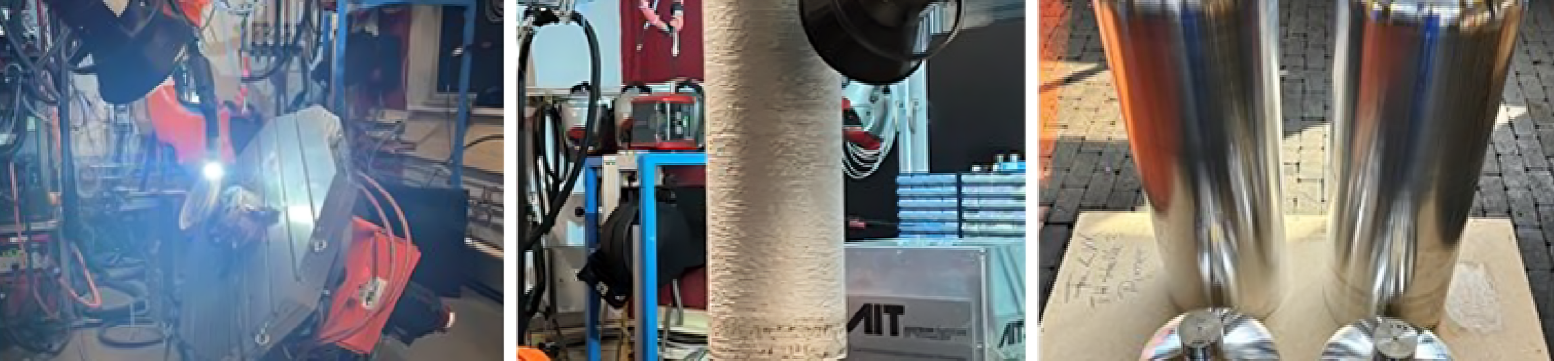
All three use-case components have progressed to full-scale manufacturing. The project submitted its deliverable covering the three full-scale prototypes in May 2026. Testing has produced encouraging results while also revealing technical challenges that would have been difficult to identify at laboratory scale. The lessons learned are helping the consortium improve process reliability and define the next development steps towards industrial use.

Adding intelligence inside manufactured components:

DISCO2030 has also demonstrated how optical-fibre sensors can be incorporated into metallic and composite components. The sensors successfully measured distributed temperature and mechanical response with a spatial resolution of 1 cm. Temperature gradients were measured up to 500°C, and the sensors continued to function in compact, curved configurations. This proof of concept opens opportunities for future components that can monitor temperature and deformation from within the structure, supporting condition monitoring and predictive maintenance. Milestone M9, covering the successful integration and evaluation of optical-fibre sensors in a proof-of-concept component, has been achieved.


From research to impact:

DISCO2030 is creating impact not only through its demonstrators, but also through the practical expertise being developed by the consortium. The project is strengthening European knowledge in hybrid and multi-material additive manufacturing, supporting new cooperation between industry and research and contributing to future European supply chains. The results are also informing follow-up research activities in areas such as space propulsion, compact heat exchangers, hydrogen storage, smart components and hybrid manufacturing.

What comes next:

The consortium will continue consolidating final demonstration and testing results, validating engineering models and documenting lessons learned from the three use cases.

  • Improving the repeatability and reliability of the manufacturing solutions
  • Advancing exploitation and business planning
  • Supporting future standardisation for multi-material additive manufacturing
  • Sharing the final demonstrator results with industry, researchers and the general public
  • Disseminating project outputs with the scientific community
  • Building pathways towards higher technology readiness and future industrial applications

The final results will provide an important foundation for continuing the development of lighter, smarter and more efficient components beyond DISCO2030.

Project Consortium

Disclaimer and Disco Logo

Funded by the European Union. Views and opinions expressed are however those of the author(s) only and do not necessarily reflect those of the European Union or European Commission. Neither the European Union nor the European Commission can be held responsible for them. The European Commission's support for the production of this publication does not constitute an endorsement of the contents, which reflect the views only of the authors, and the Commission cannot be held responsible for any use which may be made of the information contained therein. Project Number: 101091860.